On 11 May 2017, I was in Morocco, touring with a group of friends. This is what I recorded in my diary about a journey to the western end of the Sahara Desert.
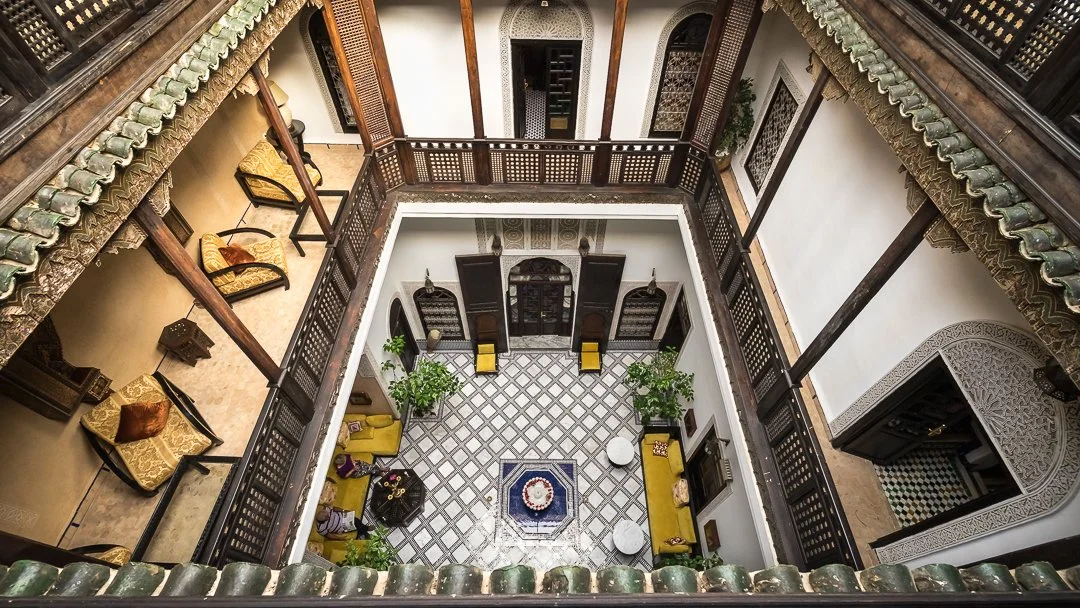
Hôtel Riad la Maison Bleue, Fes, Morocco.
We left Hotel Riad Maison Bleue in Fes (above) at 0800 and arrived at our desert tent camp near the Algerian border 12 hours later, after crossing the Atlas mountains, which form the spine of Morocco running diagonally across the country, more or less north east to south west, with the highest peak at 4,360 metres.
The scenery changed from green farmlands south of Fes to an alpine plateau, which is snow-covered in winter but is used for grazing in summer. There are no fences, so shepherds tend the flocks of sheep and goats. What a mind-numbing existence they appear to have, alone all day with the animals, enduring all kinds of weather conditions and living in homes that look not so different to those images we see of refugee camps.
As the altitude increased, the mountains became arid, barren and rocky with dramatic hills and valleys. We finally emerged onto a desolate, stony plane that reminded me a little of the scenery along the Stuart Highway between Woomera and Coober Pedy. Now the weather had changed from pleasant sunshine to overcast, with a strong wind stirring up the dust.
We stopped at a little community somewhere and transferred to five Four Wheel Drive vehicles for the final 50 km drive to camp. The wind had picked up, and we plunged into a sand/dust storm that sometimes reduced visibility so that we could only see one or two of the centreline markings on the road. That worry disappeared when we turned off the road onto a stony plane. The vehicles spread out, travelling in an impressive line, with the more distant ones disappearing into the gloom. This was accentuated by the impending sunset just an hour away.
Then we began to see sand drifts, which progressively increased in size, slowing progress. Unknown to us in the lead car, one of the following cars became briefly bogged in a sand drift. Then we crossed a final dune, and there was the camp, a circle of tents awaiting us, with a red carpet (!) barely visible, as its shag-pile served as an excellent sand catcher. The world of the camp was a muted shade of orange thanks to the dust and sand in the air. Nothing could be seen of the environment beyond the tents.
The full fury of the wind was revealed when we emerged from the car. Wind speeds of 47 km/h had been forecast, and we seemed to be experiencing their maximum intensity. I suddenly realised that traditional Arab clothing made so much sense. The one-piece overclothing has no places where sand can collect. The turban-come-scarf keeps sand out of the hair and ears and could be arranged to protect the face. But there was no way to protect the eyes from the stinging sand.
So here we were, on the western edge of the great Sahara Desert, and it had turned on a memorable welcome for us!
The Sahara Desert
We were welcomed in the customary way with a glass of hot tea, served by young Berber men in their traditional bright blue clothing. They then led us to our tents, but walking was difficult when leaning into the wind with eyes closed against the stinging sand.
The spacious, sturdy tents had inner and outer linings that shook and made disturbing noises under the onslaught of the wind, but the air was calm inside. An ensuite bathroom was discreetly hidden behind a curtain. Lighting and water supply were understandably basic, hot water being heated by a wood fire and the whole camp powered by PV panels.
Dinner was served, but I had a minimal amount of food, not wanting to further upset my Delhi-Belly. Then went to my tent to dust the sand off the bed, have a cleansing shower, and retire. Surprisingly, I had no trouble sleeping despite the 35-degree heat, the wind noise and the vibrations transmitted to the bed via the bedhead, which was against the windward-facing tent wall.
I woke at 0530 to the sound of hand clapping and shouts of, “Are you coming? It’s time for the camels.” For a moment, I thought about going back to sleep, but remembered I was here because, during trip planning, I had identified it as a significant highlight. Emerging from the tent, I was surprised to see that the air was calm, the sky cloudless, and, in the desert silence, the predawn light was beautiful.
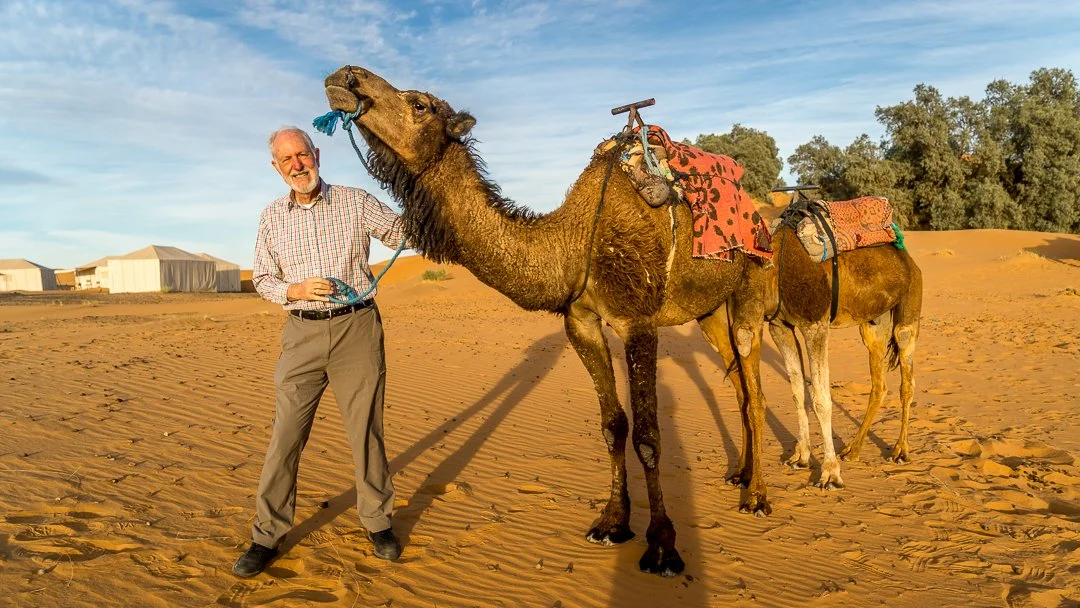
Me and my camel at Et-Taous. Note, no stirrups - Painful on the inner thighs!
After a fortifying espresso, we mounted the camels and wound our way up the dunes for 30 minutes to the highest dune, where we could observe the sunrise. The clear air revealed a sea of rolling dunes to the east. To the west was the almost full moon in a pastel-blue sky, streaked with soft clouds, above the stony plane we had crossed the previous day in the sandstorm. Dark rows of mountains lined the horizon. Absolutely breathtaking! So glad I didn’t stay in bed.
The dust storm and high winds had ‘groomed’ the dunes, leaving them in pristine condition with no trace of footsteps made by visitors on the previous day.
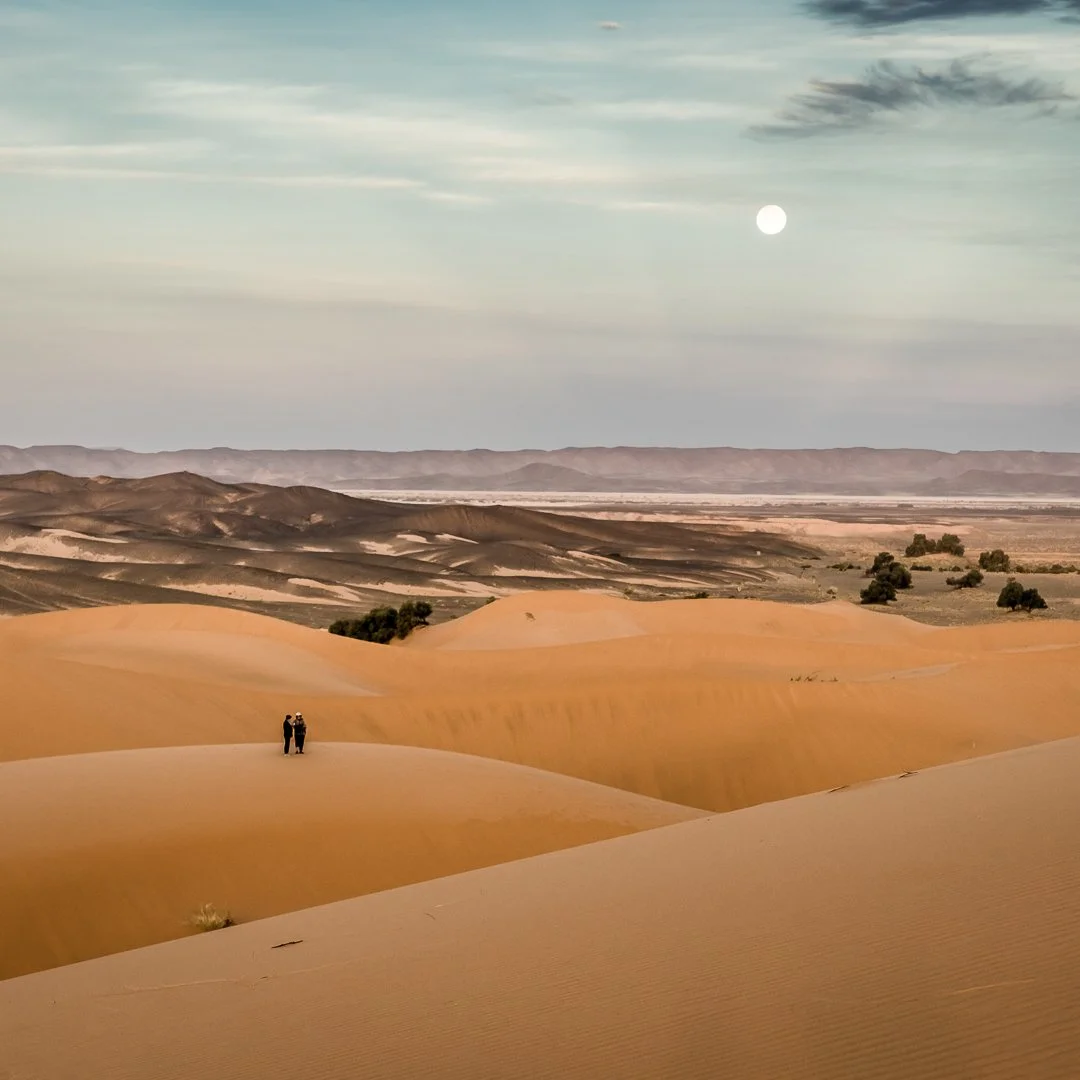
The view to the west before sunrise.
While everybody stood on top of a dune to watch the sunrise, I did what photographers do and looked in the opposite direction for memorable images. Noteably, our guides and camel handlers were waiting in a line on the edge of a dune - a perfect spontaneous composition for a photo. It was all over too soon.
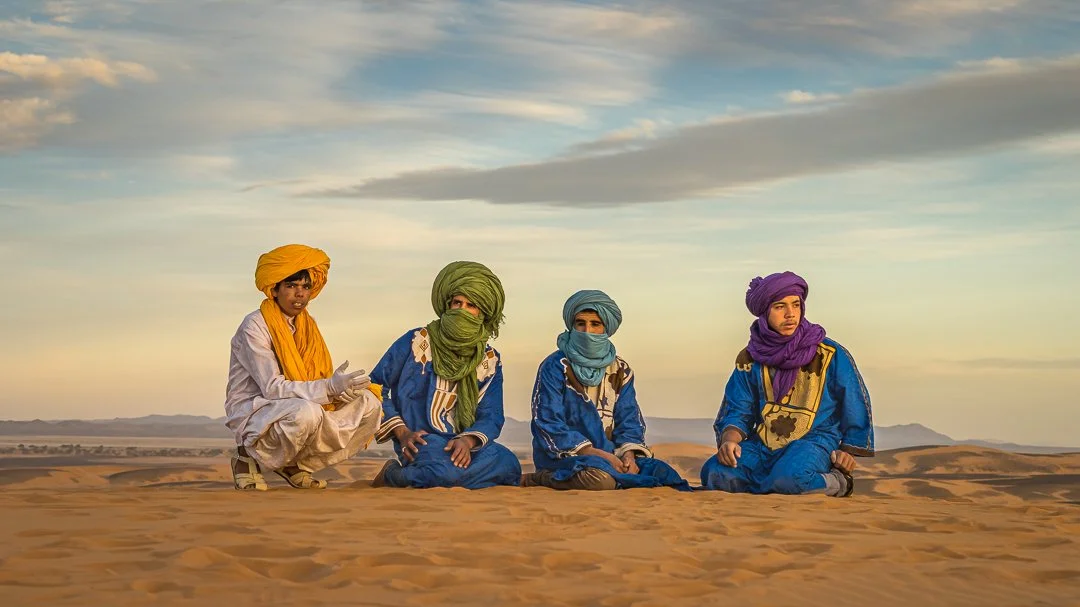
Berber men in blue, Berber boy in white.
The camels took us back to camp, and we quickly made our way into the dining tent for breakfast. Before loading our gear into the cars for the return trip, we were fair-welled with a drum and singing performance by our Berber hosts, followed, of course, by the mandatory group photo.
Driving in the clear air, we saw that the landscape we had passed through yesterday, in the gloomy cloak of the dust storm, was dotted with isolated flat-roofed mud-brick houses set in the formidable stony landscape. What the people did for a living was a mystery, but there were small villages every now and then. Perhaps tourism is the answer. There were some struggling palms and a few low shrubs, but very little colour amongst the various shades of grey and brown.
We passed a boy standing on the roadside holding something above his head. It was a baby fox. We were told he would sell it as a pet.